01
Specialist-led care
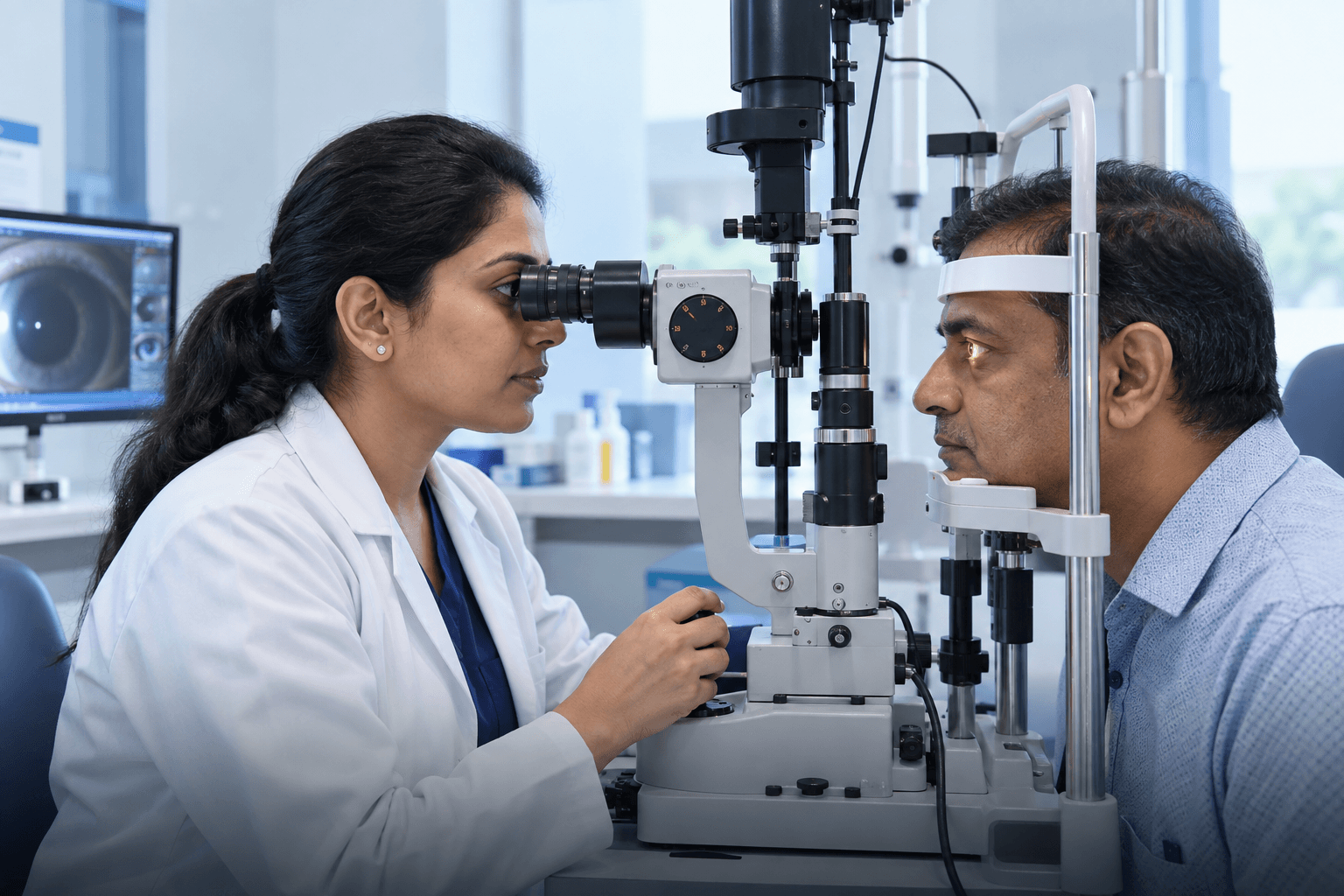
Care led by Dr. Yajuvendra Singh Rathore, MBBS, MS Ophthalmology (Reg. No: G-60559).

Advanced cataract care
Micro-incision cataract surgery using Oertli Faros technology, with topical anaesthesia in suitable cases. Treatment is planned after an individual eye examination.
Oertli Faros phacoemulsification system
1.6 mm MICS micro-incision technique
Topical anaesthesia in suitable cases
Understanding cataracts
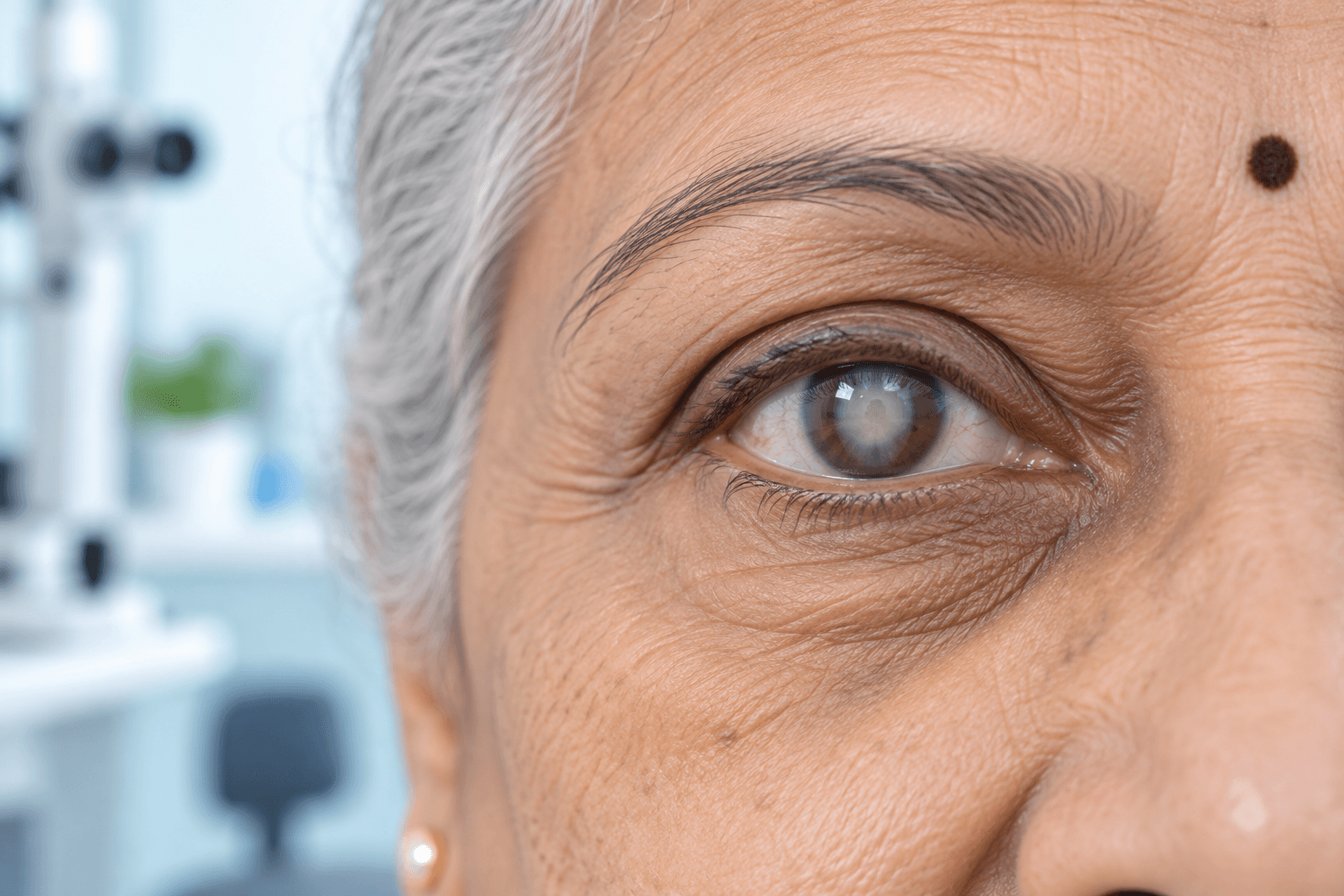
A cataract is a cloudy area in the eye's natural lens. The lens normally helps focus light on the retina so you can see clearly.
Most cataracts develop as the eye changes with age. As the lens becomes cloudier, vision may become blurry or hazy, colours can appear faded, and seeing clearly at night can become more difficult.
During cataract surgery, the cloudy natural lens is removed and replaced with an artificial lens. An eye examination helps determine when surgery is appropriate for you.


Why choose us
Specialist expertise, modern surgical technology and considerate support for patients and families across Gandhidham and the Kutch region.
Care led by Dr. Yajuvendra Singh Rathore, MBBS, MS Ophthalmology (Reg. No: G-60559).
The Oertli Faros phacoemulsification system and Zeiss Visu 160 operating microscope support precise cataract procedures.
The surgical technique and anaesthesia approach are selected after examination and according to individual suitability.
The team provides clear guidance through consultation, treatment and eligible insurance or TPA documentation.
Post-operative examinations and clear recovery guidance ensure your vision stabilizes safely after cataract surgery.
The 1.6 mm MICS technique and topical anaesthesia are used where the patient and clinical situation are suitable.
Slit-lamp examination, retinoscopy, OCT, fundus photography and visual field testing support detailed assessment.
Consultations are supported in English, Hindi and Gujarati to help patients and families understand their care.
Signs & symptoms
Cataract surgery may be considered when changes in vision begin to interfere with daily activities, safety or independence. An ophthalmologist can assess whether cataracts are the cause and discuss the right timing.
Blurred or hazy vision interferes with reading, work or other daily activities.
Clinical next step: detailed cataract assessmentUpdated glasses no longer provide enough improvement for everyday tasks.
Glare, halos or difficulty seeing at night makes driving or moving around less comfortable.
Colours appear faded or less vivid than before.
Double vision or frequent vision changes are affecting one eye.


Treatment options
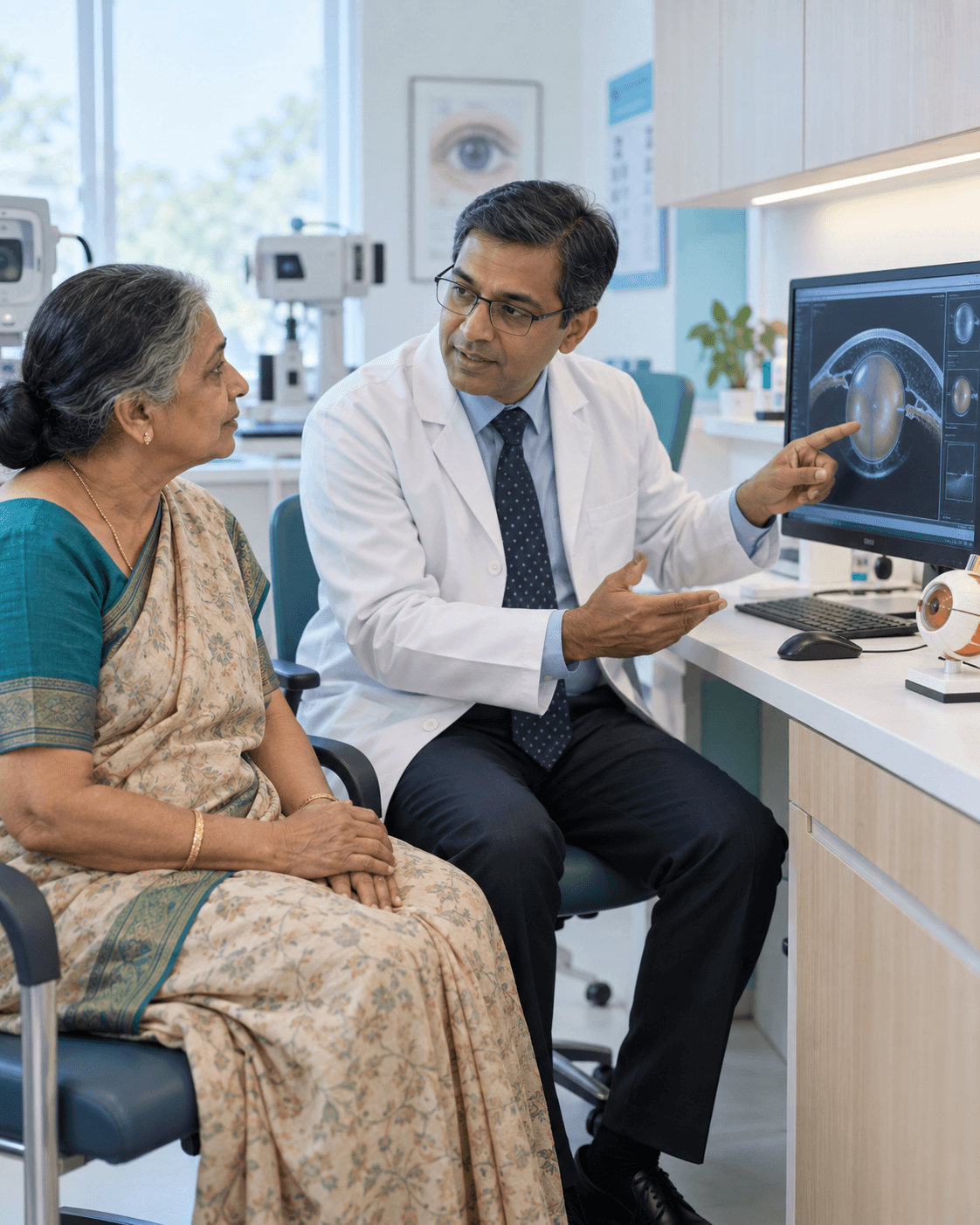
A cataract occurs when the natural lens of the eye becomes cloudy, making vision blurry or hazy. You may find it harder to read, drive, recognise faces or carry out everyday activities. After examining your eyes, our doctor will explain the available treatment options and help you understand which approach may be right for you.
This technique uses ultrasound energy to break the cloudy lens into smaller pieces, which are then removed and replaced with an artificial lens.
This procedure removes the cloudy lens through a small incision in the eye. Your doctor will determine whether this technique is suitable for you.
This technique uses a very small incision to remove the cloudy lens, where appropriate for the patient's eye condition.
For suitable patients, cataract surgery can be performed using anaesthetic eye drops instead of an injection around the eye. Your doctor will explain whether this option is appropriate for you.
Cataracts can also affect children. An eye specialist will assess the child's condition and discuss the appropriate treatment and care.
Sometimes, the thin membrane behind an artificial lens becomes cloudy after cataract surgery. A YAG laser procedure may be recommended to help restore clearer vision.
Lens options
Types of intraocular lenses (IOLs)—choose the option that best suits your lifestyle with guidance from your ophthalmologist.

Provides clear vision at one distance, usually far. Reading glasses may still be needed for close work.

Enables clear vision at multiple distances—near, intermediate and far—reducing dependence on glasses.

Provides a continuous range of clear vision from distance to intermediate, with minimal glare and enhanced night vision.

Specially designed to correct astigmatism while providing clear distance vision in one procedure.

Provides clear distance vision with the potential for improved intermediate vision, depending on the lens design and individual needs.
Lens availability and suitability vary. No lens can guarantee complete freedom from glasses; your surgeon will explain expected benefits, limitations and possible visual effects.
Side-by-side guide
See how common intraocular lens designs differ. Your ophthalmologist will recommend an option after examining your eyes and understanding your daily vision needs.
Swipe horizontally to compare all options
| Feature | MonofocalStandard lens | Enhanced MonofocalENHANCED MONOFOCAL LENS | EDOF IOLExtended depth of focus | Toric LensAstigmatism correction | MultifocalMultiple focus lens |
|---|---|---|---|---|---|
| Lens design |  | |  |  |  |
| Primary focus | One selected distance | Distance with functional intermediate | Distance to intermediate | Distance with astigmatism correction | Multiple focal zones |
| Distance vision | Commonly selected | Supported | Supported | Supported | Supported |
| Intermediate vision | Glasses may be needed | May support everyday tasks | Designed to support | Depends on lens design | Designed to support |
| Near vision | Reading glasses often needed | Reading glasses often needed | Reading glasses may be needed | Depends on lens design | Designed to support |
| Astigmatism correction | Separate correction may be considered | Toric variants may be available | Toric variants may be available | Designed for suitable regular astigmatism | Toric variants may be available |
| Possible need for glasses | Often for near tasks | Often for near tasks | May remain for near tasks | Varies by selected design | May be reduced |
Lens illustrations are representative. Lens suitability, availability and expected visual range vary between patients. No lens can guarantee complete freedom from glasses.
PRE-OPERATIVE ASSESSMENT
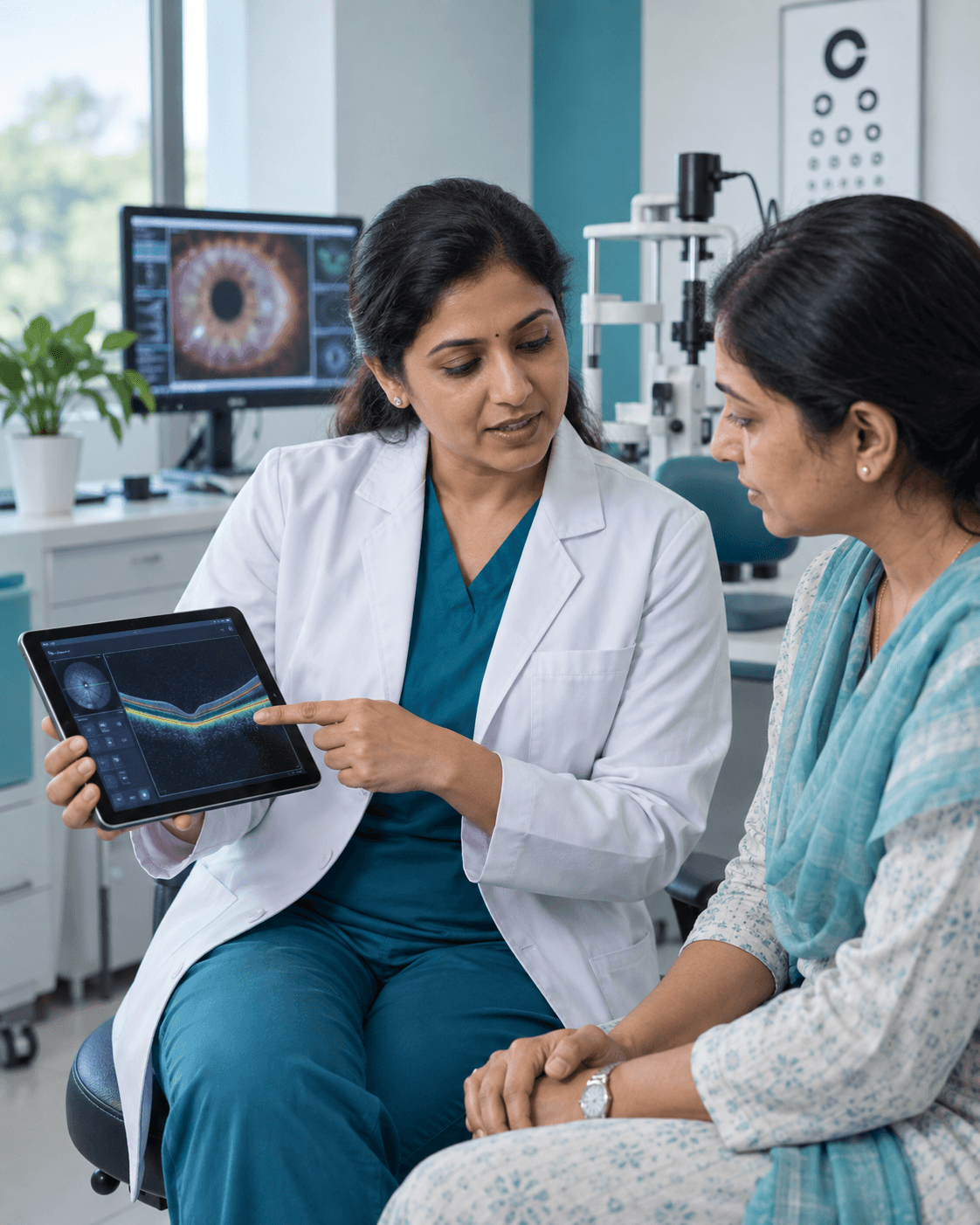
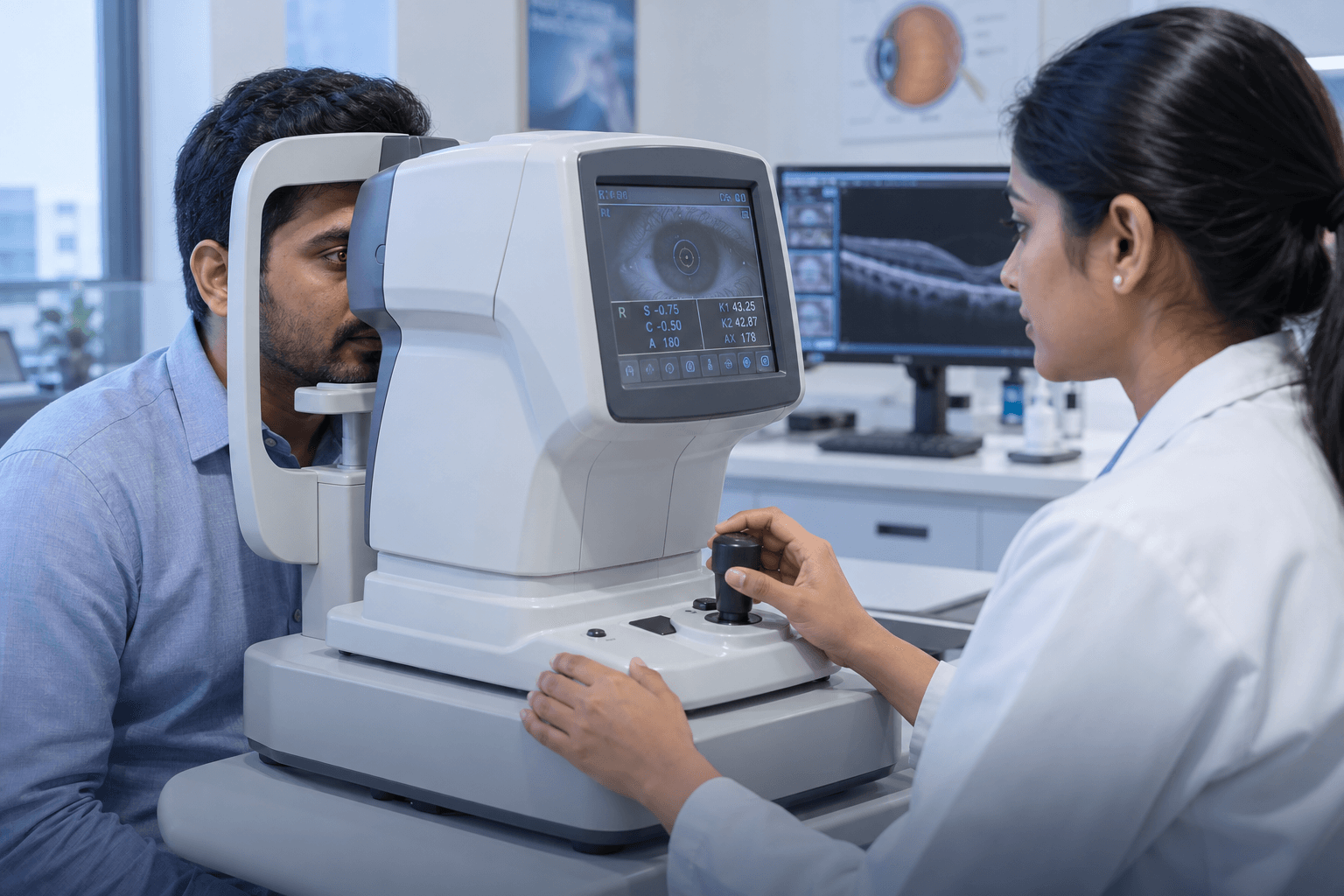
Optical biometry helps measure important dimensions of the eye before cataract surgery. These measurements help the doctor calculate the appropriate power of the artificial lens, known as an intraocular lens (IOL). The final lens choice depends on your eye measurements, eye health and individual vision needs.

Cataract surgery replaces the cloudy natural lens with an artificial lens, with the aim of improving useful vision and everyday comfort.
Replacing a clouded lens may reduce glare and haloing, helping with comfort in low light.
Removing the cloudy lens may improve clarity for reading, faces and everyday surroundings.
Many people notice colours appear brighter after the clouded natural lens is replaced.
Results vary with the health of the eye, the selected lens and individual healing. Your ophthalmologist will discuss realistic expectations before surgery.
Patient Care
Our team provides eye consultations, diagnostic evaluations and treatment planning based on each patient's individual eye health needs.
Eye examinations help our doctors assess your symptoms and eye health to determine the appropriate next steps for your care.
Eye examinations and diagnostic tests help our doctors assess eye conditions and guide clinical decisions.
Our doctors discuss suitable treatment options and recommend follow-up care according to each patient's individual needs.
Helpful guidance about cataract surgery, lens selection, recovery and what to expect from your consultation.

Most patients are surprised by how comfortable the procedure is. We use topical anaesthetic drops in suitable cases, which eliminates the need for an injection around the eye. You may feel mild pressure, but pain is not expected. If you feel anxious, let us know — we will take care of you.
The surgical procedure itself typically takes 10–15 minutes per eye. You will spend additional time for preparation and monitoring before and after. Most patients are discharged the same day.
Recovery varies by individual. Many patients notice improved vision within a day or two. Your surgeon will give you specific guidance on activity restrictions based on your case.
Yes, a cornea assessment is usually part of planning. It helps your surgeon judge corneal shape and health so the right lens and technique can be chosen for you.
Diabetes can affect the eyes, and careful assessment is essential. Our team will evaluate the health of your retina and overall control before recommending any procedure. Please bring your recent blood sugar and HbA1c reports.
Yes. We regularly see patients from Adipur, Anjar, Bhachau, and across the Kutch region. Please call or WhatsApp us to schedule a convenient appointment time.
Appointments are preferred and help us give you adequate time. Walk-ins are seen subject to availability. You can book quickly via WhatsApp or phone.
Take the first step
Book a cataract consultation to discuss your symptoms, eye health and treatment options with the Neyani Eye Hospital team.
Your consultation includes an eye examination and discussion of suitable next steps.